Evergreen huckleberry
Vaccinium ovatum
- Food part reported in sources
- Fruit
- B.C. seasonal planning window
- Not yet verified — no B.C. harvest months assigned
- Habitat
- Open, dry to moist lowland and montane forest. Frequent in southwestern B.C.; the botanical account also records rare occurrence near Prince Rupert.
An occurrence record or historical food-use report is not permission to harvest or proof of safe preparation.
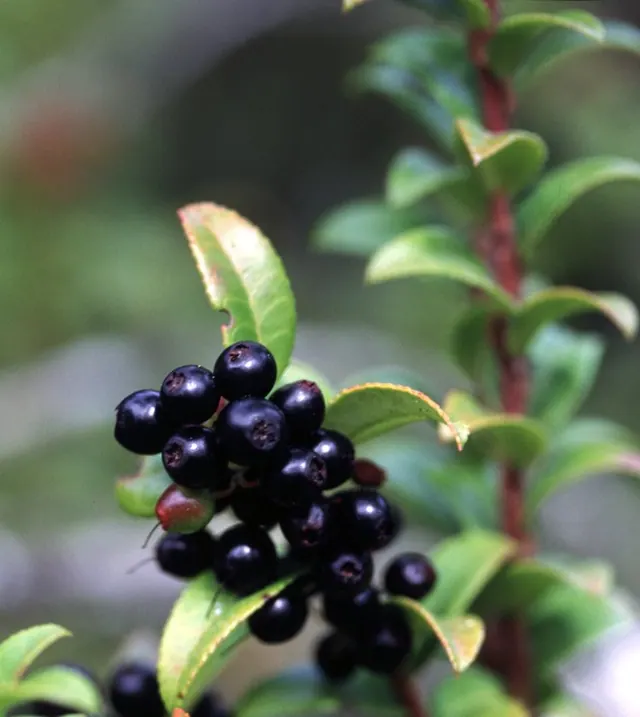
Photo: Gordon Leppig & Andrea J. Pickart · Public domain
Reference illustration. A photograph alone cannot confirm identification or edibility.
Confirm species and the intended edible part using the linked reference.
Habitat in British Columbia
Open, dry to moist lowland and montane forest. Frequent in southwestern B.C.; the botanical account also records rare occurrence near Prince Rupert.
Ecosystem records
Coastal Douglas-fir (CDF); Coastal Western Hemlock (CWH); Engelmann Spruce–Subalpine Fir (ESSF); Interior Cedar–Hemlock (ICH); Mountain Hemlock (MH); Sub-Boreal Spruce (SBS)
UBC recorded ecosystems for the named taxa. Ecosystem records describe broad associations, not known patches or harvesting permission.
Timing and food-use notes
Not yet verified — no B.C. harvest months assigned. Weather, elevation and local conditions can change timing.
Verify the exact species, intended part and preparation with a qualified regional identifier. Months describe planning windows only.
Features to Study
The shrub retains its glossy, leathery leaves. Leaves are alternate, pointed and sharply toothed; small flowers occur in clusters along the stems.
The fruit is small and dark purple to black. E-Flora BC describes it as sweet and edible, but those qualities should never be tested on an unidentified berry.
Study the whole organism with the linked regional reference. This is an introduction, not a complete identification key.
Comparisons & Common Confusions
Salal also has evergreen leaves and dark fruit, but its leaves are generally larger and its hanging flower clusters differ. Red huckleberry has conspicuously green angled twigs and red fruit. Compare attached leaves and fruit with the source photographs; berry colour alone is insufficient.
Plan the Outing
A species-specific harvest calendar has not yet been verified in this guide. Use All year to explore the documented ecosystem associations and treat your first visit as observation. Do not interpret the lack of assigned months as absence or as a recommendation to harvest throughout the year.
Handling & Kitchen Notes
After identification, carry berries in a small container and sort them before use. For a first recipe, work with a modest amount and record the flavour and texture. Shop-bought fruit is a useful substitute when an outing provides too little for a dessert; there is no need to strip a shrub to meet a recipe quantity.
References
Repeated source URLs are combined above. A source may support more than one fact; it is not counted as independent verification twice.