Himalayan blackberry
Rubus armeniacus
- Food part reported in sources
- Fruit
- B.C. seasonal planning window
- August, September
- Habitat
- Lowland fencerows, ditches, disturbed edges and moist sites, especially in southwestern B.C. A visible roadside patch is not necessarily a suitable food-collecting site.
An occurrence record or historical food-use report is not permission to harvest or proof of safe preparation.
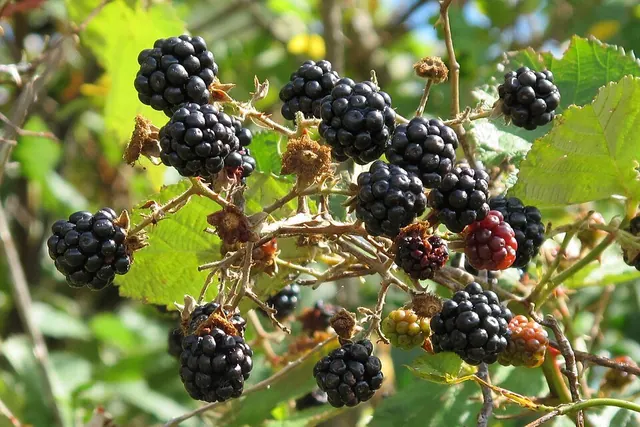
Photo: Katrin Schneider / korina.info · CC BY-SA 4.0
Reference illustration. A photograph alone cannot confirm identification or edibility.
Typically August–September on the coast.
Habitat in British Columbia
Lowland fencerows, ditches, disturbed edges and moist sites, especially in southwestern B.C. A visible roadside patch is not necessarily a suitable food-collecting site.
Ecosystem records
Coastal Douglas-fir (CDF); Coastal Western Hemlock (CWH); Interior Cedar–Hemlock (ICH)
UBC recorded ecosystem zones. Ecosystem records describe broad associations, not known patches or harvesting permission.
Timing and food-use notes
August, September. Weather, elevation and local conditions can change timing.
Verify the exact species, intended part and preparation with a qualified regional identifier. Months describe planning windows only.
Features to Study
Look at the high, arching canes, strong hooked prickles and compound leaves. First-year canes commonly have five leaflets; flowering canes often have three.
The ripe black fruit is a cluster of drupelets. This is an introduced invasive shrub, distinct from B.C.’s native trailing blackberry.
Study the whole organism with the linked regional reference. This is an introduction, not a complete identification key.
Comparisons & Common Confusions
Trailing blackberry usually sprawls close to the ground with finer prickles, while Himalayan blackberry forms much larger arching thickets. Examine foliage and canes as well as fruit. Do not propagate an invasive patch or move cut canes to another site.
Plan the Outing
August–September is the guide’s coastal planning window. Ask about access and spray history, and avoid unsafe roadside stopping. Long sleeves and a shallow container make a modest outing easier; do not push into a dense thicket to reach the last fruit.
Handling & Kitchen Notes
Sort positively identified fruit and rinse before use. Our original Blackberry & Oat Crumble is a starting idea that also works with shop-bought fruit. Keep the recipe separate from identification: a dessert instruction does not make an uncertain berry safe, and baking is not a preservation method for storing food at room temperature.
References
Repeated source URLs are combined above. A source may support more than one fact; it is not counted as independent verification twice.