Thimbleberry
Rubus parviflorus
- Food part reported in sources
- Fruit
- B.C. seasonal planning window
- July, August
- Habitat
- Moist open woodland, clearings, thickets and stream margins. Recorded widely in southern B.C., including montane and subalpine settings.
An occurrence record or historical food-use report is not permission to harvest or proof of safe preparation.
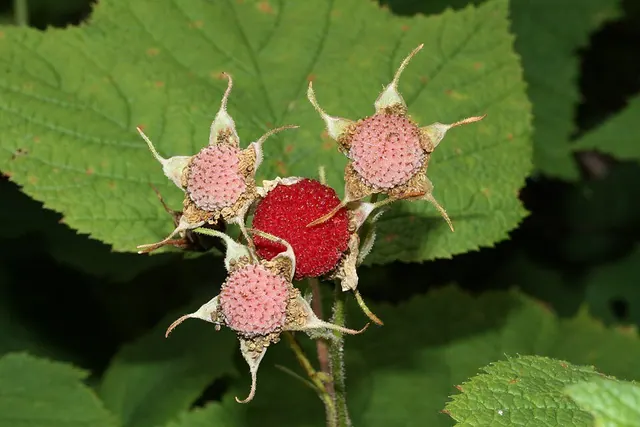
Photo: Walter Siegmund (talk) · CC BY-SA 3.0
Reference illustration. A photograph alone cannot confirm identification or edibility.
Usually July–August; timing varies with elevation.
Habitat in British Columbia
Moist open woodland, clearings, thickets and stream margins. Recorded widely in southern B.C., including montane and subalpine settings.
Ecosystem records
Bunchgrass (BG); Boreal White and Black Spruce (BWBS); Coastal Douglas-fir (CDF); Coastal Western Hemlock (CWH); Engelmann Spruce–Subalpine Fir (ESSF); Interior Cedar–Hemlock (ICH); Interior Douglas-fir (IDF); Mountain Hemlock (MH); Montane Spruce (MS); Ponderosa Pine (PP); Sub-Boreal Pine–Spruce (SBPS); Sub-Boreal Spruce (SBS)
UBC recorded ecosystem zones. Ecosystem records describe broad associations, not known patches or harvesting permission.
Timing and food-use notes
July, August. Weather, elevation and local conditions can change timing.
Verify the exact species, intended part and preparation with a qualified regional identifier. Months describe planning windows only.
Features to Study
Look for broad, maple-shaped leaves, white flowers and stems without the strong prickles of blackberry. The leaves are commonly divided into three to seven lobes.
The ripe red fruit is a rounded cluster of small drupelets that comes away from its receptacle. Study those features together, rather than relying on the red colour.
Study the whole organism with the linked regional reference. This is an introduction, not a complete identification key.
Comparisons & Common Confusions
Salmonberry’s leaves are compound, typically with three leaflets; thimbleberry has one broad, lobed leaf. Bigleaf maple also has large lobed leaves but is a tree with opposite leaves and paired winged fruits. Similar leaf shape is an invitation to compare, not proof of identity.
Plan the Outing
July–August is the guide’s planning window. Photograph flowers or developing fruit on an earlier visit, then compare the same broad site later in the season. Keep access and road safety in mind even when a plant grows in an easy-to-see clearing.
Handling & Kitchen Notes
Bring a shallow container and avoid adding heavy fruit on top. After positive identification, sort out debris and damaged berries. Work with the amount you can gather lightly: a small sauce or topping is more practical than planning a large batch before knowing what is available.
References
Repeated source URLs are combined above. A source may support more than one fact; it is not counted as independent verification twice.